Cross-price elasticity is an important concept in economics that helps explain how the demand for one product responds to changes in the price of another. It measures the responsiveness of the quantity demanded of one good to a price change in another related good. Understanding elasticity allows businesses, economists, and policymakers to analyze relationships between products, such as substitutes and complements.
By studying this concept, organizations can better predict consumer behavior, design effective pricing strategies, and make informed market decisions. It also helps identify whether products compete with each other or are used together, making it a valuable tool for market analysis and economic planning.
| Aspect | Explanation |
| Cross-Price Elasticity | It measures how demand for one good responds to changes in the price of another good. |
| Formula | CPE = % Change in Quantity Demanded of Good A ÷ % Change in Price of Good B |
| Positive Elasticity | Indicates substitute goods where an increase in the price of one product increases demand for another (e.g., coffee and tea). |
| Negative Elasticity | Indicates complementary goods where an increase in the price of one product decreases demand for the other (e.g., printers and ink). |
| Zero Elasticity | Shows unrelated goods, meaning price changes in one product do not affect the demand for another (e.g., umbrellas and smartphones). |
| Key Factors Affecting CPE | Nature of goods, availability of alternatives, time horizon, consumer preferences, market conditions, and brand loyalty. |
| Business Applications | Helps companies set competitive prices, develop marketing strategies, and analyze competitor pricing. |
| Economic Importance | Used by economists and governments to study consumer behavior, taxation impacts, and market competition. |
| Role in Market Analysis | Helps understand product relationships, competitive levels, and market demand patterns. |
Cross-Price Elasticity

Cross price elasticity of demand (CPE) is a fundamental economic concept that measures how the quantity demanded of one good responds to changes in the price of another good. This metric is essential for understanding consumer behavior and the interrelationship between products. It helps businesses, policymakers, and economists make informed decisions on pricing, product development, and market strategy.
Formula
The formula for calculating cross-price elasticity of demand is expressed as follows:
CPE=% Change in Quantity Demanded of Good A% Change in Price of Good BCPE = \frac{\%\ \text{Change in Quantity Demanded of Good A}}{\%\ \text{Change in Price of Good B}}CPE=% Change in Price of Good B% Change in Quantity Demanded of Good A
This formula consists of two parts: the percentage change in quantity demanded of Good A and the percentage change in price of Good B. The resulting value provides insights into whether the goods in question are substitutes, complements, or unrelated. A positive CPE indicates a substitution relationship, while a negative CPE suggests a complementary relationship.
Types

Cross-price elasticity can be categorized mainly into three types based on the sign of the elasticity.
Substitutes
When the goods are substitutes, an increase in the price of one good leads to an increase in the quantity demanded of the other. For example, if coffee prices rise, consumers might buy more tea as an alternative.
Complements
Complements exhibit negative cross-price elasticities. In this case, a rise in the price of one good leads to a decrease in the quantity demanded of the complementary good. For instance, if the price of printers increases, consumers are likely to buy less printer ink, since printers and printer ink are often used together.
Unrelated Goods
Unrelated goods demonstrate a zero elasticity, meaning that changes in the price of one good have no significant effect on the quantity demanded of the other. For example, an increase in umbrella prices is unlikely to affect smartphone demand, suggesting a lack of connection between the two products.
Factors Affecting
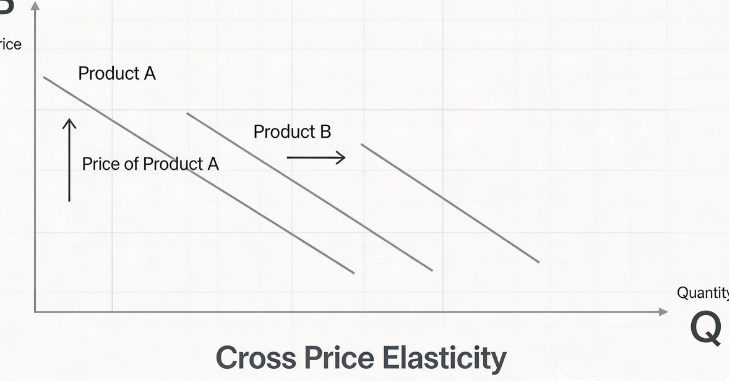
Several factors influence cross-price elasticity, and understanding them can help stakeholders better navigate market dynamics.
- Nature of Goods: The nature of the goods plays a significant role; substitutes generally exhibit positive elasticity, while complements show negative elasticity. The inherent relationship between products affects how consumers adjust their purchasing decisions in response to price changes.
- Availability of Alternatives: The availability of alternatives significantly affects elasticity. When more substitutes are available, consumers can easily switch products in response to price changes, thereby increasing the elasticity of demand. This flexibility encourages consumers to seek better options when prices rise.
- Time Horizon: Time horizon is another crucial aspect to consider. In the short term, consumers may be less responsive to price changes due to established habits and preferences. However, over the long run, they may adjust their behaviors more readily as they explore new options and preferences evolve.
- Consumer Preferences: Consumer preferences can shift due to trends or new information, further affecting cross-price elasticity. For instance, a health trend may increase demand for organic products, significantly altering the relationship with other goods that serve as substitutes or complements.
- Market Conditions: Market conditions also play a vital role in shaping elasticity. Economic factors, such as recessions or periods of growth, can affect consumer spending habits, thereby influencing how demand responds to price changes.
- Brand Loyalty: Finally, brand loyalty can diminish the elasticity of substitution between substitutes. A loyal customer of a particular soft drink may be less sensitive to competitors’ price changes than casual consumers, making them less likely to switch brands even when prices rise.
Applications

Understanding cross-price elasticity has practical applications across various sectors. For businesses, CPE can inform pricing strategies. By analyzing how demand responds to competitors’ price adjustments, firms can optimize their pricing to remain competitive. Additionally, companies may leverage elasticity in marketing campaigns by promoting complementary products to boost sales.
Economists and market analysts use CPE to analyze consumer behavior, which can guide product development and market-entry strategies. Governments also find this concept valuable when crafting policies, such as taxes. Understanding the elasticity of a product can reveal the potential economic impacts of taxation on consumption patterns.
Lastly, CPE plays a critical role in mergers and acquisitions. Analyzing cross-price elasticities between products helps stakeholders understand the potential market effects of a merger, guiding regulatory reviews and decisions.
Conclusion
Cross-price elasticity of demand is a vital concept that offers insights into the relationships between products in the marketplace. By tracking how the quantity demanded of one good responds to changes in the price of another, stakeholders can navigate consumer behavior and market dynamics more effectively.
Classifying goods into substitutes, complements, and unrelated products provides clarity about market relationships. Factors affecting elasticity, including the nature of goods, market conditions, and consumer preferences, are crucial for a nuanced understanding of demand.
In practical applications, CPE serves as a robust tool for businesses to form pricing strategies, shape marketing campaigns, and inform policy decisions. It is instrumental in studies of economics and market behavior, reflecting its significance for understanding the complexities of consumer interactions and market structure.
Want to know about Townhomes For Rent: All About Benefits of Renting a Townhome, Average Cost of Townhomes for Rent, Townhomes for Rent vs Apartments, And Much More Check out our Real Estate category.
FAQs
The Cross Price Elasticity of Demand (sometimes referred to as cross elasticity) is an economic concept that quantifies the responsiveness in the quantity demanded of one product when the price of another product changes.
The cross price elasticity of demand will be negative when two goods are complements. Complementary products are goods that are consumed together. If the price of one good falls, demand for its complement will increase, and vice versa.
If the XED value exceeds 1, this indicates that the two goods in question are close substitutes; i.e., as the price of Good B rises by 1%, the quantity demanded of Good B will rise by more than 1%. The closer the substitutability between products, the greater the positive XED value becomes.
When price elasticity is 0.5, it means that with a % change in the price of the own commodity, the % change in quantity demanded would be half of the others. Since elasticity is less than 1, demand is inelastic.