
In the modern financial system, global currencies play a central role in shaping international trade, cross-border investment, and reserve management policies. They are measured by liquidity strength, reserve allocation, and transaction volume in foreign exchange markets. The leading currency accounts for about 58% of global reserves and nearly 88% of total forex turnover, while the second-largest accounts for close to 20%.
Daily trading activity exceeds $7.5 trillion across key hubs such as New York, London, Tokyo, and Singapore. More than half of global trade invoices and over 40% of payment flows depend on global currencies. Backed by bond markets exceeding $25 trillion and advanced systems such as SWIFT, these currencies support hedging, pricing, and risk management worldwide.
| Basics | Details |
| Business Role | Ranked by liquidity and reserves |
| Dollar Share | 58% reserves, 88% turnover |
| Euro Position | About 20% global reserves |
| Expansion Impact | Cuts volatility, improves forecasting. |
| Trade Invoicing | Over half of the invoices are denominated. |
| Forex Volume | $7.5T daily market turnover |
| Trading Hubs | New York, London, Tokyo, Singapore |
| Reserve Mix | 55% primary, 20% euro |
| Rate Drivers | Inflation, jobs interest influence |
| Digital Systems | SWIFT CHIPS real-time settlement |
| Risk Control | Hedge 70–90% exposure |
| Commodity Pricing | Oil, gold, and gas are quoted |
| Yuan Growth | 3–4% global payments share |
| Market Ranking | $25T bonds 40% payments |
| USD Value | 1 USD equals 1 |
| EUR Value | 1 EUR is about 1.08 USD |
What Are Global Currencies in Business Terms?
In international commerce, currencies dominating cross-border settlements are ranked by liquidity, reserve share, and invoicing power. The United States Dollar accounts for roughly 58% of allocated reserves and nearly 88% of forex turnover. The Euro follows near 20%, while the Japanese Yen and British Pound Sterling maintain smaller but strategic global transaction shares.
Drive Corporate Expansion

For multinational enterprises, pricing exports in global currencies reduces volatility exposure and strengthens revenue forecasting accuracy. Over 50% of global trade invoices use the leading reserve currency, reducing foreign exchange costs by approximately 2–3% per contract. Treasury teams implement hedging strategies using forwards, swaps, and options to stabilize earnings and protect quarterly profit margins.
Foreign Exchange Market Size and Trading Data
The foreign exchange market exceeds $7.5 trillion in daily average turnover, making it the largest financial marketplace worldwide. Trading hubs in New York, London, Tokyo, and Singapore operate across overlapping sessions. Swaps represent about 49% of transactions, while spot trades account for nearly 28%, supported by advanced electronic communication networks and algorithmic systems.
Reserve Allocation Strategies
Central banks structure portfolios around global currencies to preserve liquidity and capital security. Typical reserve allocations range from 55–60% in the primary reserve unit, 20% in the euro area currency, and smaller portions in Asian assets. Diversification ratios help reduce sovereign exposure while maintaining access to deep sovereign bond markets.
Exchange Rate Mechanisms
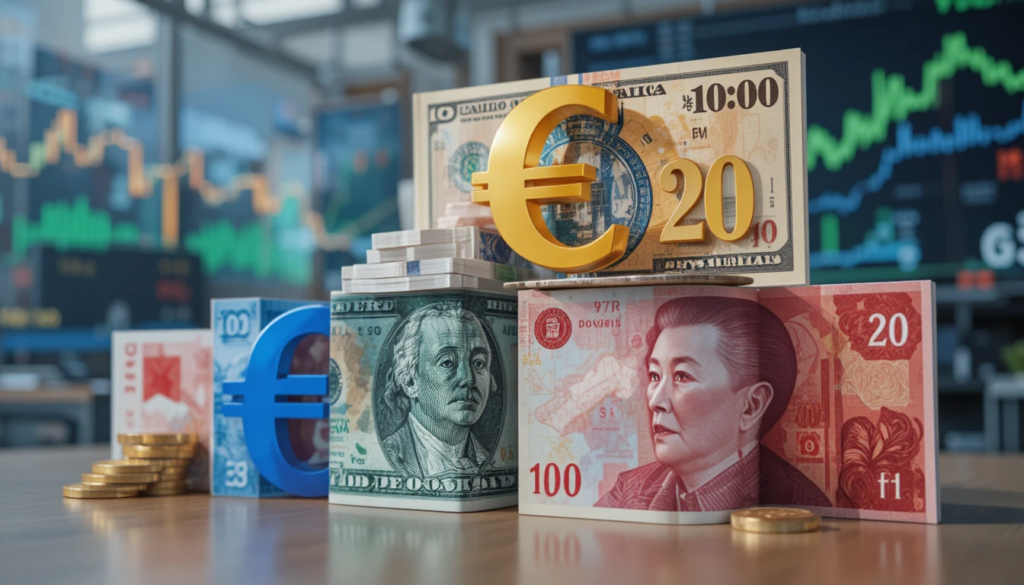
Floating exchange regimes respond to macroeconomic signals, including inflation, employment data, and interest rate changes. A one-percent rate increase can attract short-term capital inflows that strengthen a currency within weeks. Weighted benchmarks such as the Dollar Index track performance against six major peers, providing investors with comparative valuation metrics.
Digital Infrastructure
Financial infrastructure accelerates global currencies transfers through SWIFT messaging, CHIPS settlement systems, and real-time gross settlement platforms. Transaction settlement cycles have declined from T+2 days to near-instant processing in advanced markets. Corporate treasury departments integrate AI-based analytics dashboards to monitor volatility spikes and automatically rebalance hedge positions efficiently.
Corporate Risk Management
Companies generating 30–50% of revenue internationally calculate currency sensitivity using value-at-risk models and stress testing scenarios. Firms often hedge 70–90% of projected foreign cash flows with futures and cross-currency swaps. Treasury analytics platforms measure basis spreads, volatility indexes, and counterparty ratings to reduce operational exposure.
Commodity Pricing

Global currencies heavily influence commodity benchmarks, as crude oil, gold, and natural gas contracts are primarily quoted in the dominant reserve unit. Energy exporters rely on standardized pricing formulas tied to international exchanges. Automated pricing software adjusts export quotations when exchange rate volatility exceeds 2%.
Regional Momentum
The Chinese Yuan accounts for about 3–4% of global payment share, reflecting expanding Asian trade flows. The yen remains popular for funding strategies due to historically low yields. European markets continue issuing euro-denominated bonds, strengthening cross-border investment channels and regional capital integration.
Competitive Ranking

Liquidity depth, sovereign bond market scale exceeding $25 trillion, and payment settlement share above 40% sustain the first-place ranking. Global currencies compete on regulatory transparency, capital mobility, and digital integration capabilities. Robust financial governance frameworks and scalable infrastructure systems remain decisive advantages for maintaining long-term monetary leadership.
10 Major Currencies and Their Approximate Values
The primary reserve currency holds about 58% of global reserves and leads commodity pricing worldwide.
- United States Dollar (USD) – 1 USD = 1 USD: The primary reserve currency holds about 58% of global reserves and leads commodity pricing worldwide.
- Euro (EUR) – 1 EUR ≈ 1.08 USD: Second-largest reserve asset with around 20% allocation and a strong eurozone bond market backing
- Japanese Yen (JPY) – 1 USD ≈ 150 JPY: Frequently used in carry trades, supported by deep liquidity and export-driven economic strength.
- British Pound Sterling (GBP) – 1 GBP ≈ 1.27 USD: Major financial trading currency with significant presence in derivatives and forex markets.
- Swiss Franc (CHF) – 1 CHF ≈ 1.10 USD: Considered a safe-haven asset during inflation spikes and geopolitical uncertainty periods.
- Canadian Dollar (CAD) – 1 USD ≈ 1.35 CAD: Commodity-linked currency is closely tied to crude oil exports and North American trade.
- Australian Dollar (AUD) – 1 USD ≈ 1.50 AUD: Influenced by mining exports and Asia-Pacific regional trade demand cycles.
- Chinese Yuan (CNY) – 1 USD ≈ 7.20 CNY: Growing in cross-border settlements and bilateral trade agreements globally.
- Indian Rupee (India currency) (INR) – 1 USD ≈ 83 INR: Expanding regional trade currency supported by rapid GDP growth and services exports.
- Singapore Dollar (SGD) – 1 USD ≈ 1.34 SGD: Backed by strong financial governance and a major Southeast Asian financial hub positioning.

Conclusion
In conclusion, global currencies remain the foundation of international finance and trade efficiency. With the leading currency holding about 58% of global reserves and participating in nearly 88% of forex transactions, its dominance is clear.
Daily trading volumes exceeding $7.5 trillion and bond markets above $25 trillion highlight their scale. As over 40% of global payments and more than half of trade invoicing rely on global currencies, their influence will continue shaping corporate strategy, reserve management, and economic stability worldwide.
Want to know about Currency Markets: Comprehensive Analysis, Emerging Trends, and Strategic Insights for Investors and Financial Professionals Check out our Marketing category.
FAQs
A currency becomes internationally dominant when it is widely used for trade settlements, held in central bank reserves, and trusted for stability, liquidity, and strong financial-market backing.
Companies favor stable foreign units because they reduce exchange risk, improve pricing accuracy, lower transaction costs, and create predictable revenue forecasts in cross-border operations.
The foreign exchange market processes trillions of dollars daily, making it the largest financial marketplace, operating continuously across major global trading centers and time zones.
Firms use financial instruments such as forwards, futures, swaps, and options to limit exposure, stabilize cash flow, and protect profit margins from sudden exchange rate shifts.
Central banks maintain foreign reserves to stabilize domestic currencies, support international payments, manage crises, and strengthen investor confidence during periods of economic uncertainty.